D Dimer The Clot Question
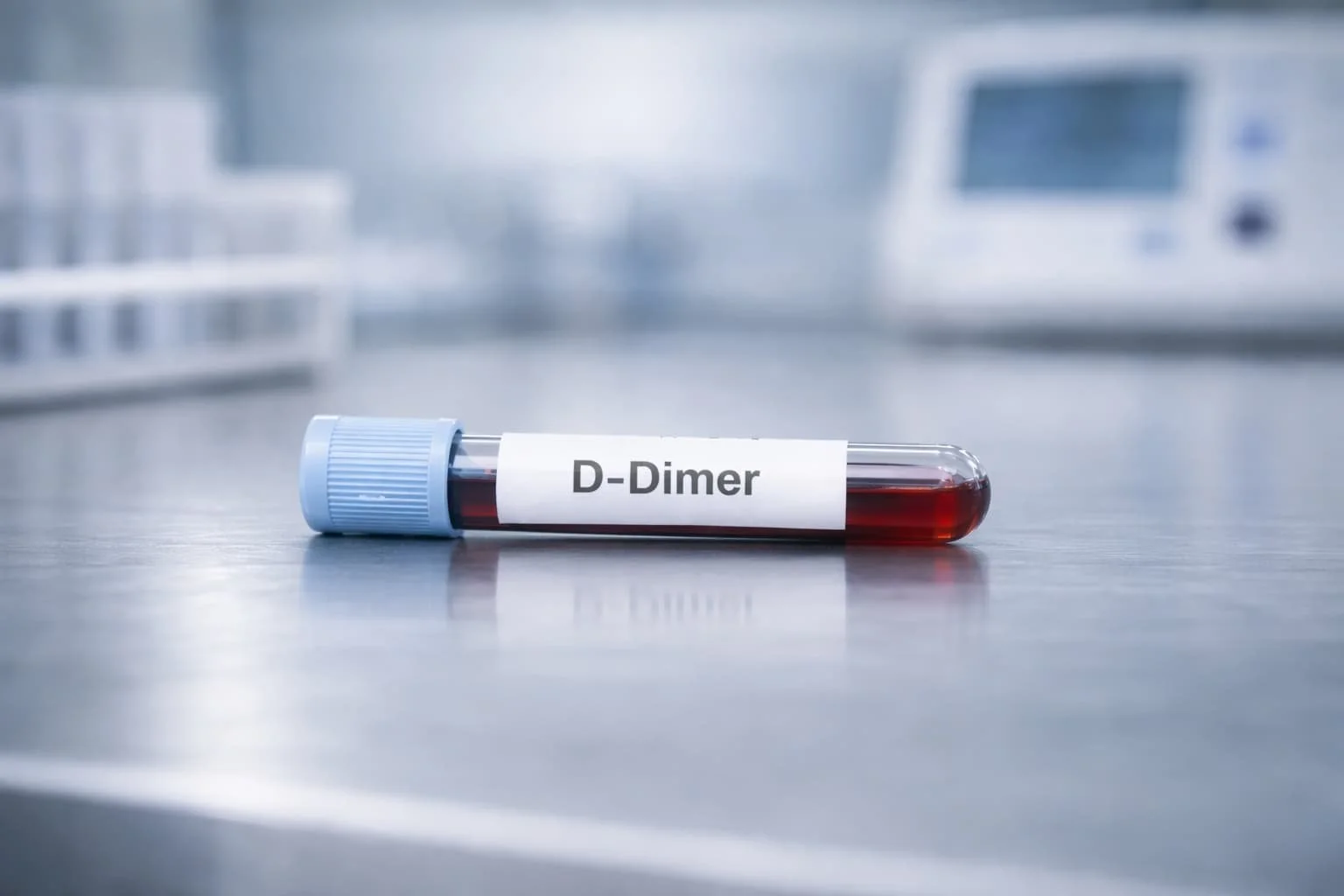
A blood test that helps us rule out dangerous clots
When We Worry About a Clot
A patient comes in with sudden shortness of breath. Another has new swelling and pain in one leg. Someone else has sharp chest pain that worsens with breathing.
In those moments, we worry about blood clots. A clot in the leg is called a deep vein thrombosis. A clot that travels to the lungs is called a pulmonary embolism. These can be serious. Sometimes life-threatening. The D-dimer test helps us decide who needs more advanced imaging.
What D-Dimer Actually Measures
D-dimer is a blood test that detects fragments produced when the body breaks down a blood clot. Your body is constantly forming and dissolving tiny clots. When a significant clot forms and begins to break down, D-dimer levels rise. An elevated D-dimer means clot breakdown is happening somewhere. It does not tell us where. It does not tell us why.
That is why D-dimer is a screening tool, not a diagnosis.
Why We Do Not Scan Everyone
The definitive tests for clots are imaging studies. Ultrasound can detect clots in the legs. CT scans or specialized lung scans can detect clots in the lungs. But those tests take time. Some involve radiation and contrast dye. We do not want to expose patients to unnecessary imaging if their risk is low.
D-dimer helps us safely rule out clots in low-risk patients. If the clinical suspicion is low and the D-dimer is normal, the likelihood of a dangerous clot is extremely small. A normal D-dimer in the right patient can prevent unnecessary imaging.
When D-Dimer Can Be Misleading
D-dimer is sensitive. It is not specific. Levels can rise for many reasons besides clots. Infection, inflammation, recent surgery, trauma, pregnancy, and even normal aging can increase the value. That means an elevated D-dimer does not automatically mean a clot is present.
Because D-dimer naturally rises with age, we often adjust the cutoff in older patients. This helps avoid unnecessary scans while maintaining safety. The test is most useful when the patient’s overall risk is low to moderate. If clinical suspicion is already high, imaging is usually performed regardless of the D-dimer result.
What About Other Conditions?
D-dimer can sometimes assist in evaluating other serious conditions, such as aortic dissection. In carefully selected low-risk patients, it may help guide whether advanced imaging is necessary.
But like troponin, the number alone never makes the decision. It must be interpreted alongside symptoms, exam findings, and overall risk.
THE BOTTOM LINE
• D-dimer detects clot breakdown in the body.
• A normal result in a low-risk patient can safely rule out many dangerous clots.
• An elevated result does not confirm a clot and must be interpreted in context.
By Dr. Karim Ali, Emergency Physician