What an Arterial Blood Gas Reveals
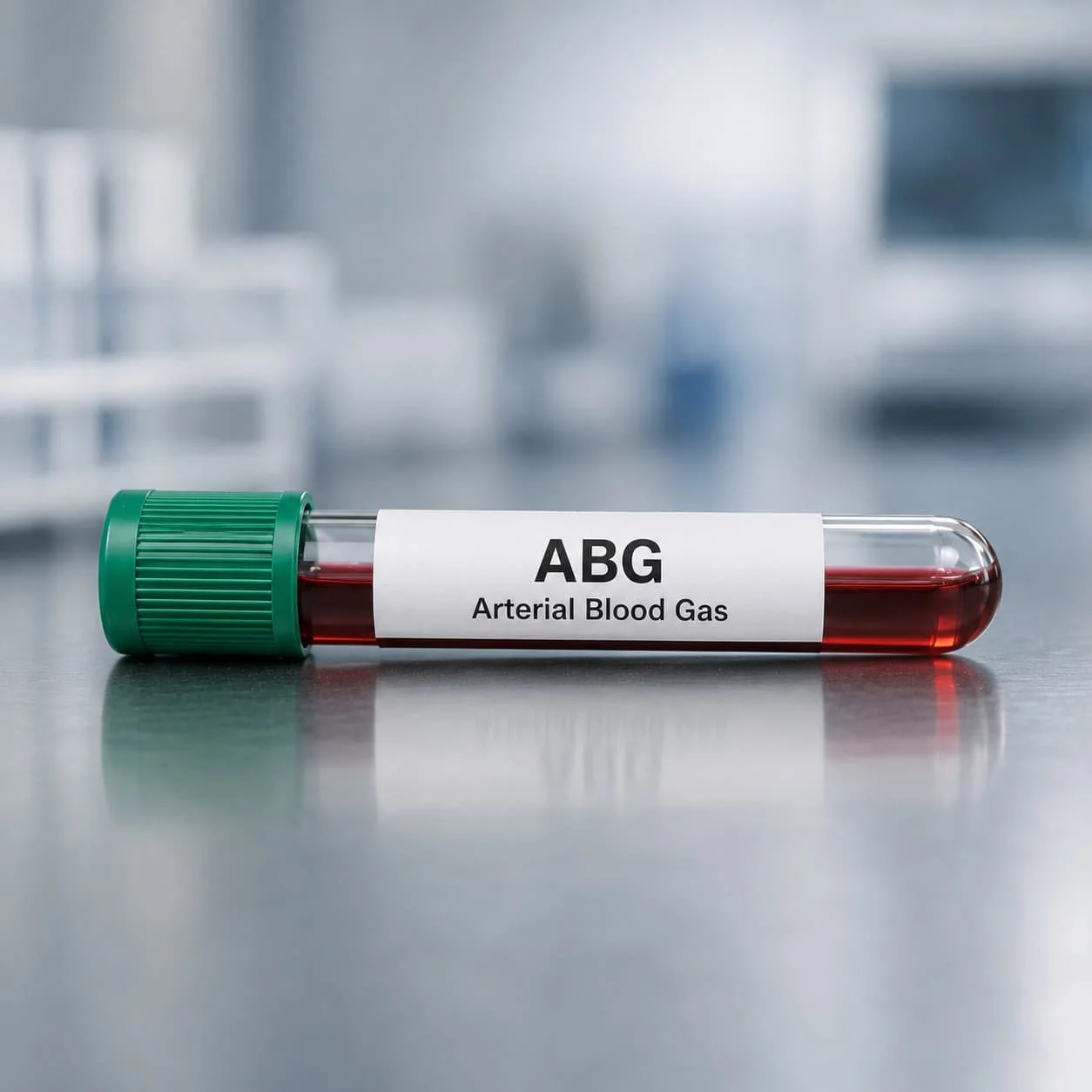
The arterial blood gas is one of the most uncomfortable tests in emergency medicine. Here is what it tells us, and why it can matter so much.
Most blood tests are drawn from a vein in your arm, quick and barely memorable. So when someone in the ER reaches instead for the artery in your wrist, it tends to get your attention. That stick is sharper, more deliberate, and almost never routine. Here is what we are looking for when we do it, and why the answer sometimes changes everything in minutes.
The Stick Patients Remember
An arterial blood gas is usually ordered when we are worried someone's breathing is beginning to fail.
Alex, 68, came in breathing hard and could barely finish a sentence without stopping for air. He had lived with COPD for years, but this felt different even to him. The nurse drew blood from his arm like usual, then a respiratory therapist arrived with a smaller syringe and reached for his wrist instead. He winced immediately, and patients almost always remember that second stick.
When we reach for the artery, we are usually no longer asking small questions. We want to know how well the lungs are actually working, whether oxygen is getting into the blood, and whether carbon dioxide is building up. Most of all, we want to know if the body is starting to lose its balance, and we want the answer before the body decides for us.
Experienced ER doctors often recognize this kind of trouble before a monitor fully shows it. Someone breathing too slowly, speaking in fragments, or looking strangely calm during a breathing emergency can raise concern long before a number ever flashes red.
The Blood Test That Reads the Lungs Directly
An ABG gives us a real-time picture of how the lungs are handling oxygen and carbon dioxide.
An arterial blood gas, usually called an ABG, is a blood sample taken directly from an artery instead of a vein. Most are drawn from the radial artery near the thumb side of the wrist. That location matters more than it looks, because the source of the blood changes the whole meaning of the result.
Veins carry blood after the body has already used up its oxygen. Arteries carry blood fresh from the lungs, so an ABG shows us what the lungs delivered only seconds earlier. That makes it one of the most accurate ways to measure oxygen levels and acid balance in the body.
There are many numbers on an ABG, but in emergency medicine we usually look at three first: oxygen, carbon dioxide, and pH. The oxygen level tells us whether enough is reaching the bloodstream. The carbon dioxide level tells us whether the lungs are clearing waste gas, and a rising number is one of the earliest signs that someone is tiring out.
The pH tells us whether the blood is becoming dangerously acidic or alkaline. Each number matters on its own, but together they tell the story of how much trouble the body is really in, and how fast that trouble is moving.
When the Finger Monitor Is Not Enough
Pulse oximeters are useful, but they are not perfect. Back to Alex for a moment. His pulse oximeter, the small clip on the finger, read 82%, but the number kept fluctuating and did not look reliable. Cold hands, poor circulation, movement, and even dark nail polish can all interfere with that reading, so we drew the ABG to see the truth.
His oxygen was low, but the bigger problem was his carbon dioxide, which was extremely high. That single result changed the situation immediately. High carbon dioxide tells us the lungs are no longer keeping up with the work of breathing, and that is a quiet kind of danger.
Patients can look tired, sleepy, or even relatively calm while this is happening. Comfort is not always safety, and that gap is exactly what the test is built to expose.
Alex went on BiPAP, a tight mask that pushes air into the lungs and helps blow carbon dioxide out. Without that intervention, some patients eventually require intubation and a ventilator, so catching the slide early is everything. The ABG let us see his deterioration while there was still time to reverse it.
The Gentler Version We Often Prefer
Good emergency medicine is not about ordering every test. It is about ordering the right one.
Diabetic ketoacidosis or DKA, is another situation where blood gases become important. In DKA the body cannot properly use sugar for fuel, so acid builds up in the bloodstream and patients often breathe rapidly and deeply as the body tries to compensate. Here the pH matters enormously, because it tells us how severe the acid buildup has become.
But we often do not need an artery to answer that question. A venous blood gas, called a VBG, comes from a regular IV blood draw and can still give useful information about pH and carbon dioxide. It is less painful and carries fewer risks than reaching for the artery.
That tradeoff matters because an ABG is not without risk. The artery sits deeper, closer to nerves, and under higher pressure than a vein, so bleeding, bruising, and soreness are all possible afterward.
So if a VBG can safely answer the question, we usually choose the gentler option. Sometimes the most experienced decision in emergency medicine is simply knowing which test not to order.
What the Number Means and What It Does Not
A single abnormal value is the beginning of a question, not the end of one. This is the part patients often misread. An alarming number on an ABG does not automatically mean the worst. A low oxygen level might reflect a chronic lung condition the body has already adjusted to, and a high carbon dioxide level might be normal for someone who has lived with severe COPD for years.
The number only means something when we read it against the person in front of us. That is why we never treat the result in isolation. We weigh it against how you look, how you are breathing, your history, and how fast things are changing.
A frightening value in a comfortable patient and a borderline value in a deteriorating patient are two very different emergencies. The ABG is one of the sharpest tools we have, but it is still just one voice in the room. The doctor reading it is the one who decides what it means.
THE BOTTOM LINE
• An arterial blood gas measures oxygen, carbon dioxide, and blood pH directly from an artery, giving doctors a real-time picture of how well the lungs are working.
• It is used most in severe breathing problems like COPD, asthma, and respiratory failure, and sometimes in dangerous acid buildup like DKA, where a gentler venous draw can often answer the question instead.
• A very high carbon dioxide level or a severely abnormal pH can signal that a patient is tiring out or entering a true emergency, often before it is obvious from how they look.
Get The Emergency File. Free 13-page PDF. We run an ABG when we need answers fast. The fastest answers, though, are the ones you already brought, your medications, conditions, and history in one place before you need it. Fill it once. Keep it where someone can find it.
Ask the ER Doctor
-
An ABG is drawn from an artery and measures oxygen, carbon dioxide, and pH accurately. A VBG comes from a normal vein, the same kind of draw used for routine bloodwork, and it answers most of our questions about pH and carbon dioxide without the deeper, more painful stick. When oxygen levels are not the main concern, a VBG is often the kinder choice that still tells us what we need to know.
-
Usually, yes. The artery sits deeper than a vein and lies closer to a nerve, so the stick feels sharper and more intense. The discomfort is brief, and a skilled clinician can often get the sample on the first try. We only reach for the wrist when the information it gives us is worth that extra discomfort.
-
Sometimes the body hides how much trouble it is in. A person can look calm or even a little sleepy while carbon dioxide quietly climbs, or breathe quickly to compensate for dangerous acid buildup. The ABG helps us catch those hidden situations before they become emergencies, which is exactly why we sometimes order it even when you feel relatively stable.
By Dr. Karim Ali, Emergency Physician